Does Rent Control Make Housing Affordable?
What a cap on rents does, who gains, who pays, and what the evidence shows
Start Here: A Freeze in New York
On June 25, 2026, New York City’s Rent Guidelines Board voted 7 to 1 to freeze rents on about one million rent-stabilized apartments, roughly two of every five rental units in the city. For leases that begin between October 1, 2026, and September 30, 2027, the allowed increase is 0 percent, on one-year and two-year leases alike. A year earlier, the board had allowed increases of 3 percent and 4.5 percent. The board had frozen one-year leases three times between 2015 and 2021, but it had never before frozen two-year leases.
Both sides came with numbers. The board’s own index showed that the cost of running buildings with stabilized apartments rose 5.3 percent over the past year, with insurance up 10.5 percent and fuel up 11 percent. On the other side, the median stabilized household earned about $60,000 a year in 2023, below the $70,000 median for all New York renters, and 45 percent of stabilized households earned less than $50,000. Only 1.41 percent of the city’s rental apartments were vacant and for rent that year, the lowest rate since the city’s housing survey began in 1965. Landlord groups have challenged the freeze in court, and the case was still pending when this reading was written in November 2026.
The Foundations readings give us the tools. Where Do Prices Come From? showed that a price is a signal: a high rent tells renters to economize on space and tells builders that more apartments are wanted. Who Owns It, and Why Does It Matter? showed that owners take care of what they own when they can keep the rewards. Why Do Profits and Losses Matter? showed that profits draw in new building and losses push owners to sell, convert, or cut back. Rent control changes all three: the signal, the reward to owning, and the profit from building. Why Is Housing So Expensive? explained why rents are high in the first place. This reading asks whether capping them is a good way to help.
What Rent Control Is
Rent control is a legal limit on how much a landlord may charge or how fast the rent may rise. Economists call a legal maximum price a price ceiling. A ceiling matters only when it is binding, that is, when it sits below the rent the market would set. As the St. Louis Fed’s economic educators explain, rent control “will result in a shortage of apartments, because at the lower price the quantity of housing demanded by renters will exceed the quantity supplied by landlords.”
The graph shows the basic idea.
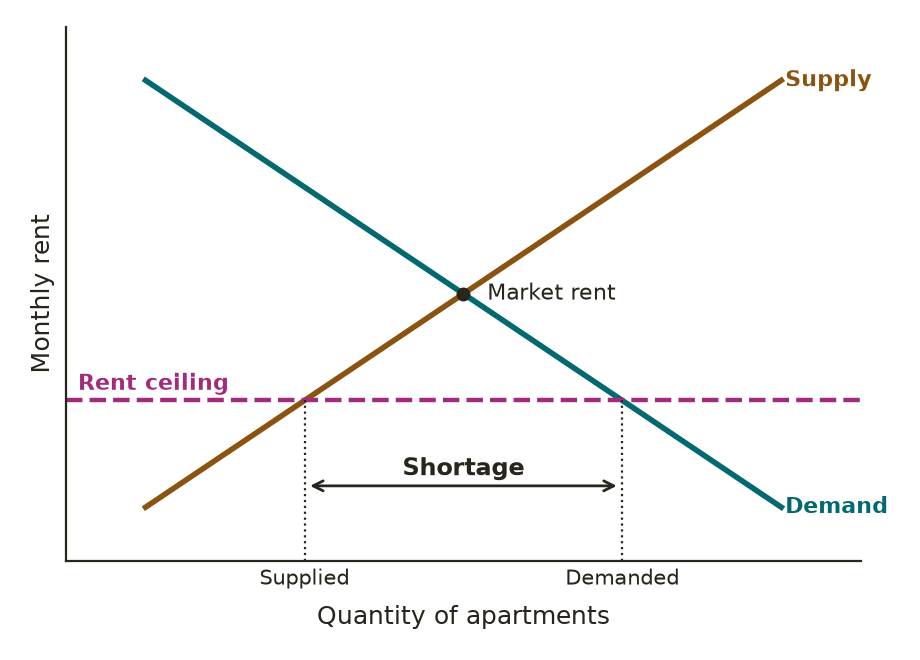
At the market rent, the number of apartments people want equals the number offered. At the lower ceiling, more people want apartments and fewer are offered. Some people pay less than before, but someone has to decide who gets the apartments that exist, since price no longer does. The decision can fall to waiting lists, luck, personal connections, or the tenants who already hold a lease. How Do People Respond to Prices? showed that supply responds more over time than right away. Rent control works the same way. In the first year, the number of buildings is fixed, so tenants simply pay less. Over the years, owners and builders respond, and the shortage tends to grow.
WATCH Price Ceilings: Rent Controls (Marginal Revolution University)
TRY IT Rent Control: The Ceiling Trap (an interactive essay by economist Alex Tabarrok of George Mason University, a critic of rent control. Drag the ceiling and watch the shortage open up.)
Not all rent control is the same. Economists often distinguish older “hard” controls from newer, softer rules:
| Type | How it works | Examples |
|---|---|---|
| Hard rent control | A fixed ceiling on the rent itself, often set years earlier, that stays with the apartment even when tenants change. | Federal wartime controls starting in 1942 and 1943; the few New York City apartments still under the older rent-control system |
| Rent stabilization | A limit on how much the rent may rise each year, often set by a board. Some versions let the rent reset when a tenant moves out; others don’t. | New York City since 1969, for most buildings of six or more units built from February 1947 to January 1974; St. Paul, Minnesota, since 2022 |
| Statewide caps | A ceiling on yearly increases tied to inflation, with an upper limit. Rents can reset between tenants, and newer buildings are exempt. | Oregon (2019): 7 percent plus inflation, no more than 10 percent; California (2019): 5 percent plus inflation, no more than 10 percent |
Three design choices shape how a rule works. Vacancy decontrol lets the rent reset to the market when a tenant moves out. A new-construction exemption leaves newer buildings free of the cap so that builders still have a reason to build. And the size of the cap decides how often it binds. A cap of 10 percent rarely binds in a normal year. A freeze binds every time costs rise.
READ Prices: The Marketplace’s Communication System (Page One Economics, Federal Reserve Bank of St. Louis, April 2013)
More Than a Shortage
The graph shows only one response: fewer apartments offered at the capped rent. But the rent is only one part of the deal. An apartment also comes with repairs, heat, a choice of tenants, and a building that could be used for something else. When the law fixes the rent, owners adjust the parts the law doesn’t fix. Economists call these other dimensions margins. Each response makes sense for the owner, and each one shifts part of the cost back onto renters.
The studies show owners using every one of these margins:
| Margin | How owners respond | What studies found |
|---|---|---|
| Upkeep and repairs | Spend less on painting, repairs, and services, because a better apartment can’t earn a higher rent. | After Massachusetts ended rent control in 1995, Boston-area units that had been controlled became about 6 percentage points less likely to have maintenance problems. In New York in 1968, small, older Manhattan buildings under control were about 9 percentage points more likely to be deteriorating or dilapidated. |
| Leaving the rental market | Convert apartments to condominiums, sell to owner-occupants, or put units to another use. | San Francisco buildings brought under control in 1994 were 8 percentage points more likely to convert to condominiums. |
| Paying tenants to leave | Offer a long-time tenant cash to move out, so the unit can be converted or its rent reset. | In San Francisco, the average buyout was more than $30,000. |
| Tearing down and rebuilding | Replace an old controlled building with new housing that is exempt. | In San Francisco, the new high-end housing drew residents with incomes at least 18 percent higher. |
| Choosing among applicants | With a line of applicants for every opening, pick the easiest tenants: small households, steady incomes, friends. | In 1946, Friedman and Stigler found that families with small children came last, and that many apartments went to those willing to pay “a considerable sum on the side—for ‘furniture.’” Oslo, a before-and-after study: before Norway ended rent control in 1982, landlords’ ads often named the tenant they wanted, by gender, age, occupation, or even religion; renters offered to babysit or shovel snow; and some deposits ran 50 to 60 months’ rent. Within a few years of decontrol these demands had mostly faded, and the share of listings that printed a rent rose from about 20 percent to about 80 percent. Advertised rents did not jump, which the study’s author reads as a sign that deposits and favors had been standing in for a higher rent. |
Builders respond too. An apartment building takes years to plan and decades to pay off, so a developer is betting on the rules over the building’s whole life, not just today’s. A cap lowers the rent a builder can expect, and the chance that a cap will be extended adds risk. New York shows why builders worry. Its 1969 rent stabilization law covered about 325,000 apartments completed after February 1947, buildings that had gone up free of rent control. In 1974, a new state law brought in apartments built from 1969 to 1974, which had been exempt from both systems. St. Paul’s first rule covered buildings not yet built. An exemption for new buildings protects building only as long as builders trust it to last. Building is also the slowest response to show up in the data. In Boston, construction changed little in the first few years after controls ended, because new buildings take years to plan.
Tenants respond too, and this is where “keeping people in their homes” gets more complicated. A below-market rent is worth something only as long as the tenant stays, so every move means giving it up. Households change: children grow up and leave, a baby arrives, a job moves across town or to another city. In an ordinary market, the rent nudges an empty-nest couple toward a smaller place and frees the larger one for a growing family. Under rent control, staying usually wins. Stanford economist Rebecca Diamond describes the result as “empty-nest households living in family-sized apartments and young families crammed into small studios.” In New Jersey, economists Robert Krol and Shirley Svorny found that towns with stricter rent control had longer commutes, because tenants stayed put when their jobs moved. That study compares places rather than following a change in the law, so it is weaker evidence than the natural experiments below. But the direction is not in doubt. Reviewing the research in 2022, economist Konstantin Kholodilin found that “all studies find a negative effect of rent control on the mobility.” Lower turnover hurts outsiders too. Every tenant who stays in an apartment they would otherwise leave is one fewer vacancy for someone who is looking.
Who Really Pays?
Few questions in economics draw as much agreement as this one, and the agreement crosses political lines. Reviewing decades of research in 2009, economist Blair Jenkins found that “economic research quite consistently and predominantly frowns on rent control,” on housing supply, upkeep, rents, and who benefits. Paul Krugman, an economist on the left, called it “among the best-understood issues in all of economics, and -- among economists, anyway -- one of the least controversial.” Assar Lindbeck, a Swedish economist who for years belonged to his country’s Social Democratic Party, wrote in 1971 that in many cases rent control appears to be “the most efficient technique presently known to destroy a city—except for bombing.” Friedman and Stigler, on the right, had made the same case in 1946.
Not every study counts equally. A simple before-and-after comparison can’t tell the effect of rent control apart from everything else going on in a city, such as a boom, a recession, or a change in interest rates. The strongest studies use natural experiments: a sudden change in the law that covers some buildings and not others that are otherwise alike, so researchers can compare the two. The four cases below are among the best of these, and they point the same way.
1 St. Paul: A strict cap, then a rewrite
On November 2, 2021, voters in St. Paul, Minnesota, approved a 3 percent cap on yearly rent increases, with 53 percent of the vote. It took effect in May 2022. It was one of the strictest rules in the country. The cap applied to every rental unit, including buildings not yet built, and the rent could not reset when a tenant moved out.
Economists Kenneth Ahern and Marco Giacoletti studied what happened to property values. In their published study, average property values in St. Paul fell 4.0 to 5.5 percent after the vote. Renters as a group gained and landlords lost, but the gains and losses did not line up the way many supporters expected. Upper-income renters gained more than lower-income renters. Small landlords lost as much as large ones. Homeowners lost too, partly because their neighborhoods became less attractive places to invest. An earlier version of the study put the point more sharply: “the realized impact of the law was the opposite of its intention.”
Building slowed as well, though this evidence is weaker, because many things changed at once. The city permitted more than 2,000 new housing units in both 2020 and 2021, the most since 1970. Permits fell to 1,169 in 2022, held at 1,204 in 2023, then dropped to 404 in 2024 and 357 in 2025. Economists at the Minneapolis Fed caution that “we don’t have hard data about what caused this drop.” Borrowing costs rose over the same years, and developers most often named trouble raising money as their biggest problem. But the owners and developers they interviewed “feel that rent stabilization has had a profound effect on the market.” At one large site, a market-rate apartment building stopped for several years, and the affordable housing planned with it stalled too.
St. Paul changed the rule twice. From January 2023, it exempted new buildings for 20 years, exempted income-restricted affordable housing, and let rents partly reset after a tenant moved out. In May 2025, it permanently exempted all buildings built after 2004. Construction at the stalled site has since restarted.
2 San Francisco: The 2018 Stanford study
In 1994, San Francisco extended rent control to small apartment buildings built before 1980. In a study first released in 2018 and published in the American Economic Review in 2019, economists Rebecca Diamond, Tim McQuade, and Franklin Qian of Stanford followed the tenants and the buildings for years afterward. Covered tenants were about 20 percent more likely to stay at their addresses and less likely to be pushed out of the city. The benefit was large: from $2,300 to $6,600 per person each year, about $2.9 billion in all, and older, long-time residents gained most.
But owners responded. Landlords whose buildings were covered cut the number of rental units in them by 15 percent, by converting them to condominiums, selling to owner-occupants, or tearing down old buildings and putting up new ones that were exempt. With fewer rentals, rents across the city rose about 5.1 percent. That cost renters about $2.9 billion, roughly the same as the gain to the covered tenants. In plain terms, the law moved money from future renters to current ones. It also changed who lived in the city. The new condominiums and apartments drew residents with incomes at least 18 percent higher, and Diamond concluded that rent control “has actually contributed to the gentrification of San Francisco, the exact opposite of the policy’s intended goal.” As the authors concluded, “while rent control prevents displacement of incumbent renters in the short run, the lost rental housing supply likely drove up market rents in the long run, ultimately undermining the goals of the law.”
3 Cambridge: The neighbors pay too
Massachusetts voters ended rent control statewide in a 1994 ballot vote, 51 to 49 percent, and controls in Cambridge ended in 1995. Economists David Autor, Christopher Palmer, and Parag Pathak found that the end of rent control raised the value of Cambridge’s housing by about $1.8 billion from 1994 to 2004, “more than $1 billion of which was due to spillovers to never-controlled houses.” When owners of controlled buildings could earn a market return again, they repaired and improved them, and the whole neighborhood became more valuable. A follow-up study found that crime in Cambridge fell by about 16 percent after decontrol. The flip side is that while controls lasted, owners of nearby homes that were never controlled bore much of the cost.
4 New York: Who gets the apartments?
When price no longer decides who gets an apartment, something else does. Economists Edward Glaeser and Erzo Luttmer compared who lives in what kind of apartment in New York with the pattern in cities without rent control. They found that “an economically and statistically significant fraction of apartments appears to be misallocated.” By their estimate, about 21 percent of New York renters lived in apartments with more or fewer rooms than they would have in a city without rent control. Some households hold on to apartments larger or better placed than they would choose at market rents, while others who would value them more can’t find one. Tenants rarely move, because moving means giving up a below-market rent.
New York’s numbers show both sides of who benefits. In 2023, 45 percent of stabilized households earned less than $50,000, and 30 percent earned $100,000 or more. Rent stabilization is tied to the apartment, not to the tenant’s income, so it helps whoever holds the lease. The city also counted about 26,000 vacant stabilized apartments that were not on the market in 2023, down from about 43,000 in 2021. Owners say many need repairs that the allowed rents won’t pay for. A 2024 report by the city comptroller found that fewer than 2,000 low-rent stabilized apartments were sitting empty because owners couldn’t afford the repairs, and it found no evidence that the 2019 state law that tightened rent rules had increased vacancies.
The Seen and the Unseen
In 1946, two young economists, Milton Friedman and George Stigler, wrote a pamphlet about the rent controls left over from World War II. It was called Roofs or Ceilings? The choice, they argued, was between rent ceilings and more roofs. “The legal ceilings on rents are the reason there are so few places for rent,” they wrote. They were not indifferent to fairness. “For those, like us, who would like even more equality than there is at present,” they argued, “it is surely better to attack directly existing inequalities in income and wealth at their source than to ration each of the hundreds of commodities and services that compose our standard of living.”
READ THE ORIGINAL Roofs or Ceilings? The Current Housing Problem (Milton Friedman and George Stigler, 1946)
The evidence from past rent controls shows both sides:
| Case | The seen | The unseen |
|---|---|---|
| San Francisco, 1994 | Covered tenants were about 20 percent more likely to stay in their homes, and long-time residents gained the most. | Owners cut covered rental units by 15 percent, and rents for everyone else rose about 5.1 percent. |
| Cambridge, 1995 | Formerly controlled tenants faced higher rents after controls ended. | Property values rose $1.8 billion, mostly at homes that were never controlled, and crime fell about 16 percent. |
| St. Paul, 2021 | Rent increases for existing tenants were held to 3 percent. | Property values fell 4.0 to 5.5 percent, upper-income renters gained the most, and building permits fell sharply. |
| New York, 2026 | Rents frozen for about one million households. | Not yet known. Watch for repairs put off, apartments kept off the market, and fewer tenants moving. |
The gains to covered tenants are real. A family that doesn’t have to move keeps its children in the same school, stays near its jobs, and keeps its neighbors. But the rule that holds a family in place also ties it there: taking a better job across the region, or moving to a home that fits, means giving up the low rent. The best studies measured those gains, and in San Francisco they were large. They also found that the costs, spread across future renters and neighbors, were at least as large.
The Case for Rent Control
Rent control has serious defenders, and their best arguments deserve a hearing, along with what the evidence says about them.
5 Justice Oliver Wendell Holmes: Housing is different
After World War I, housing in Washington, D.C., ran short, and Congress limited rents there. A landlord challenged the law, and in 1921 the Supreme Court upheld it. Writing for the Court in Block v. Hirsh, Justice Holmes argued that “Housing is a necessary of life. All the elements of a public interest justifying some degree of public control are present.” If government may limit the height of buildings to answer one public need, he reasoned, “it may limit rent” to answer another. Many supporters still begin here: housing is not like other goods, because no one can do without it. Holmes settled a legal question, whether government may limit rents. Whether it should, and whether limits help, is an economic question.
6 Richard Arnott: Not all rent control is alike
In 1995, economist Richard Arnott challenged his profession’s near-unanimous opposition. The case against rent control, he wrote, rests on models of perfectly competitive housing markets and on the experience with hard controls in New York and in Europe after World War II. Today’s softer rules are different. Renters who face moving costs and few vacancies have little bargaining power at renewal time, and a cap on increases can protect them without the worst side effects of a hard ceiling. “Economists should reconsider their blanket opposition to current rent control systems and evaluate them on a case-by-case basis,” he concluded. That was a fair challenge in 1995, before the strongest natural experiments had been done. San Francisco’s rule was exactly the soft kind Arnott had in mind. It limited increases during a tenancy, let rents reset between tenants, and exempted new buildings. It still cut the rental supply in covered buildings by 15 percent.
7 Rent control as insurance
Modern research takes one part of the case seriously. Diamond explains that long-time tenants who have “a network of friends and family, proximity to a job, or children enrolled in local schools” face large risks when rents rise, and that “rent control can provide these tenants with this type of insurance.” Her San Francisco work found that tenants did benefit from that insurance. It also found that “the overall cost of providing that insurance is very large.” Her suggestion is to keep the insurance and change who pays for it: “it may be less distortionary to offer this subsidy in the form of a government subsidy or tax credit.”
Who Gets to Set Rent Control?
The federal government controlled rents nationwide during World War II and phased the controls out in the years after. Today the question belongs mostly to the states, and they have chosen very different paths:
| Approach | Examples |
|---|---|
| State and city together | New York State law sets the rules for rent stabilization, and the city’s Rent Guidelines Board, appointed by the mayor, sets the yearly increase. State law lets the system continue only while the city’s rental vacancy rate stays below 5 percent. |
| Statewide cap | Oregon and California cap yearly increases for most older apartments, with exemptions for newer buildings, and let rents reset between tenants. |
| Left to voters and cities | St. Paul’s cap was adopted by a citywide vote and later rewritten by the city council. Massachusetts voters ended local rent control statewide in 1994. |
| Banned by the state | Many states forbid their cities to adopt rent control. South Carolina is one. |
South Carolina law says that no county or city “may enact, maintain, or enforce any ordinance or resolution which would regulate in any way the amount of rent to be charged for privately owned, single family, or multiple unit residential, or commercial rental property.” So Rock Hill could not adopt a St. Paul–style cap even if its voters wanted one. The law does let local governments set rents on property they own, or reach agreements with private owners, for example in exchange for public help with financing.
Fair Challenges
- “Rent control keeps people in their homes.” The evidence agrees. San Francisco tenants were about 20 percent more likely to stay, and stability has real value for families and older renters. But staying put is not always a gain. Moving is how many households trade up to a better job or to space that fits, and rent control makes every move costly. Some tenants stay in apartments that are too large or too far from work, and each one who stays holds a vacancy that someone else can’t rent. The same study found that future renters paid about as much as current renters gained. How much weight to give a household that is already here, compared with one that hasn’t arrived yet, is a question of values.
- “Landlords can afford it.” Some can. Supporters point out that buildings with stabilized apartments in New York still sell, and sometimes for more than before. But owners are not all wealthy. In St. Paul, small landlords lost as much as large ones, and homeowners lost too. In New York, the board’s own index showed operating costs rising 5.3 percent in a year when rents were frozen. When rents fall behind costs year after year, owners respond by spending less on upkeep, selling, or leaving units empty.
- “Modern rules exempt new buildings, so supply won’t suffer.” Exemptions help, and that is why Oregon, California, and later St. Paul adopted them. But exemptions can be changed, and builders know it. And an exemption does nothing for the buildings that are covered. In San Francisco, where new construction was exempt, owners of covered buildings still converted or sold enough units to cut their rental supply by 15 percent. Kholodilin, reviewing studies from six continents, found that rent controls “appear to be quite effective in terms of slowing the growth of rents paid for dwellings subject to control,” but that “this policy also leads to a wide range of adverse effects affecting the whole society.”
- “Just build more housing.” Most economists agree that more housing is the long-run answer, as Why Is Housing So Expensive? explains. But building takes years, and a tenant facing a large increase needs help now. Supporters see rent control as a bridge until supply catches up. The evidence suggests the bridge becomes a wall: the cap itself discourages the building and upkeep that would end the shortage, and controls adopted as emergencies, like New York’s, tend to last for generations.
- “Help renters directly instead.” Friedman and Stigler made this argument in 1946, and Diamond makes a version of it today: pay for help through taxes, such as vouchers or tax credits, rather than requiring landlords to provide it. Supporters of rent control reply that vouchers cost taxpayers money that legislatures often won’t spend, and that a voucher doesn’t help much when there are no vacant apartments to rent. Critics note that rent control has a cost too; it is simply not in the budget, so voters rarely see it. Who should pay for help to renters is a question of values.
Notice what evidence can settle and what it can’t. Whether rent control keeps tenants in place, how owners respond, and what happens to rents and building are empirical questions, and the best evidence answers them clearly. Whether stability for today’s tenants is worth higher costs for tomorrow’s renters, and whether landlords or taxpayers should carry those costs, are questions of values.
What Economics Adds
On the main effects, the best evidence is not close. Rent control helps the tenants it covers, often a great deal. Over the longer run, it shrinks the rental supply, raises rents for people who aren’t covered, lowers the value of neighboring property, and sends benefits to whoever happens to hold a lease rather than to the households with the least. Softer rules with exemptions and vacancy decontrol do less harm than hard ceilings, but San Francisco shows that they still do harm. Where economists differ is mostly over how to help renters instead: housing vouchers, tax credits, emergency aid, or rules that let more housing be built.
READ What Does Economic Evidence Tell Us about the Effects of Rent Control? (Rebecca Diamond, Brookings Institution, October 2018)
LISTEN Will a Rent Freeze Fix NYC or Make It Worse? on The Journal, Wall Street Journal, September 27, 2026. Both sides of the New York freeze: Emily Eisner, chief economist of the Fiscal Policy Institute, a left-leaning research group, makes the case for it, and Kenny Burgos, head of the New York Apartment Association, which represents landlords, makes the case against.
LISTEN A Review of Rent Control Research with Konstantin Kholodilin on UCLA Housing Voice, January 22, 2025, with transcript. An economist who has reviewed more than 200 studies summarizes what they find, good and bad.
LISTEN Michael Munger on the Perfect vs. the Good on EconTalk, April 24, 2023, with transcript. Duke economist Michael Munger, who is skeptical of rent control, discusses Roofs or Ceilings? and why policies with hidden costs stay popular.
The Normative Question
Economics can show who gains from rent control, who pays, and how owners, builders, and renters respond. It can’t decide how much weight to give a family that already lives in a neighborhood compared with a family that would like to move there, or whether the cost of helping renters should fall on landlords, on taxpayers, or on future renters. Should cities and states limit how fast rents can rise, and if so, how strict should the limit be and who should pay for the help it gives? Your answer depends on how you weigh stability for today’s tenants against more housing for tomorrow’s, and on how much you trust the people who would set the rules.
Key Terms in Plain Words
- Price ceiling
- A legal maximum price.
- Binding
- Set below the price the market would reach, so that it changes what happens.
- Shortage
- More people want to buy at the current price than sellers offer.
- Rent control
- A legal limit on the level of rent or how fast it can rise.
- Rent stabilization
- A limit on yearly rent increases, often set by a board.
- Vacancy decontrol
- A rule that lets the rent reset to the market when a tenant moves out.
- Misallocation
- Goods ending up with people who value them less than others who can’t get them.
- Spillover
- An effect of a policy on people outside it, such as owners of nearby homes.
- Incidence
- Who actually bears the cost of a policy, whoever is required to pay.
- Preemption
- A state law that stops local governments from making their own rules on a topic.
- Margin
- Any part of a deal that can be adjusted, such as upkeep, quality, or who gets the apartment.
- Unintended consequence
- A result a policy’s authors did not aim for, often working against its goal.
- Mobility
- How easily people move to a new home or a new job.
- Lock-in
- When a benefit that lasts only while you stay makes moving costly.
Sources
- Quotations, figures, examples, video, and podcasts in this sheet come from the sources below, current as of November 8, 2026.
- New York City Rent Freeze
- New York City Rent Guidelines Board, Adopted Summary of Guidelines, 2026–27 (Order 58) rentguidelinesboard.cityofnewyork.us
- New York City Rent Guidelines Board, 2026 Apartment and Loft Explanatory Statement (vote of the board) rentguidelinesboard.cityofnewyork.us
- New York City Rent Guidelines Board, 2026 Price Index of Operating Costs rentguidelinesboard.cityofnewyork.us
- New York City Rent Guidelines Board, 2026 Income and Affordability Study rentguidelinesboard.cityofnewyork.us
- New York City Rent Guidelines Board, 2026 Housing Supply Report presentation rentguidelinesboard.cityofnewyork.us
- New York City Independent Budget Office, segments of the rent-stabilized housing stock, May 2026 ibo.nyc.gov
- Reuters, “New York City Freezes Rents for One Million Apartments,” June 25, 2026 (earlier one-year freezes) reuters.com
- NY1, “NYC Rent Freeze Takes Effect amid Ongoing Legal Challenge,” October 1, 2026 ny1.com
- New York Housing Data And History
- New York City Department of Housing Preservation and Development, testimony on the 2023 Housing and Vacancy Survey, 2024 nyc.gov
- New York City Department of Housing Preservation and Development, 2023 Housing and Vacancy Survey, Selected Initial Findings nyc.gov
- Office of the New York City Comptroller, “Accurately Assessing and Effectively Addressing Vacancies in NYC’s Rent Stabilized Housing Stock,” March 12, 2024 comptroller.nyc.gov
- New York City Rent Guidelines Board, History of the Board and the Rent Regulation System rentguidelinesboard.cityofnewyork.us
- New York City Rent Guidelines Board, Glossary of Rent Regulation Terms rentguidelinesboard.cityofnewyork.us
- NYU Furman Center, CoreData directory, rent stabilization furmancenter.org
- Legal Aid Society, statement on the 2026 Price Index of Operating Costs and Mortgage Survey reports (argument) legalaidnyc.org
- Where Economists Stand
- Blair Jenkins, “Rent Control: Do Economists Agree?” Econ Journal Watch 6, no. 1 (January 2009): 73–112 econjwatch.org
- Paul Krugman, “A Rent Affair,” New York Times, June 7, 2000 (argument) archive.nytimes.com
- Assar Lindbeck, The Political Economy of the New Left: An Outsider’s View (1971), as quoted by the Research Institute of Industrial Economics (IFN), Stockholm ifn.se
- What Rent Control Is
- Federal Reserve Bank of St. Louis, Page One Economics, “Prices: The Marketplace’s Communication System,” April 2013 stlouisfed.org
- Alex Tabarrok, Rent Control: The Ceiling Trap, interactive visual essay, George Mason University, 2026 (argument) mason.gmu.edu
- Oregon Department of Administrative Services, Office of Economic Analysis, Rent Stabilization oregon.gov
- Oregon Legislature, Senate Bill 611 (2023), enrolled text olis.oregonlegislature.gov
- California Department of Justice, Office of the Attorney General, Limits on Rent Increases oag.ca.gov
- California Legislative Information, AB 1482, Tenant Protection Act of 2019 leginfo.legislature.ca.gov
- Who Really Pays
- City of Saint Paul, Rent Stabilization stpaul.gov
- Federal Reserve Bank of Minneapolis, “Housing Policies in Saint Paul Yield Mixed Results, Data and Developers Say,” June 3, 2026 minneapolisfed.org
- Kenneth R. Ahern and Marco Giacoletti, “The Redistribution of Housing Wealth Caused by Rent Control,” Journal of Urban Economics (2026) ideas.repec.org
- Kenneth R. Ahern and Marco Giacoletti, “Robbing Peter to Pay Paul? The Redistribution of Wealth Caused by Rent Control,” NBER Working Paper 30083 (2022) nber.org
- Rebecca Diamond, Tim McQuade, and Franklin Qian, “The Effects of Rent Control Expansion on Tenants, Landlords, and Inequality: Evidence from San Francisco,” American Economic Review (2019) aeaweb.org
- Rebecca Diamond, Tim McQuade, and Franklin Qian, NBER Working Paper 24181 (2018), abstract econpapers.repec.org
- Stanford Graduate School of Business, “Rent Control’s Winners and Losers.” gsb.stanford.edu
- David Autor, Christopher Palmer, and Parag Pathak, “Housing Market Spillovers: Evidence from the End of Rent Control in Cambridge, Massachusetts,” Journal of Political Economy (2014) journals.uchicago.edu
- NBER Digest, “The End of Rent Control in Cambridge.” nber.org
- American Economic Association, “Gentrification and Crime,” July 22, 2019 aeaweb.org
- David P. Sims, “Out of Control: What Can We Learn from the End of Massachusetts Rent Control?” Journal of Urban Economics 61, no. 1 (2007): 129–151 ideas.repec.org
- Joseph Gyourko and Peter Linneman, “Rent Controls and Rental Housing Quality: A Note on the Effects of New York City’s Old Controls,” Journal of Urban Economics 27, no. 3 (1990): 398–409 econpapers.repec.org
- Edward L. Glaeser and Erzo F. P. Luttmer, “The Misallocation of Housing Under Rent Control,” American Economic Review (2003) aeaweb.org
- Robert Krol and Shirley Svorny, “The Effect of Rent Control on Commute Times,” Journal of Urban Economics 58, no. 3 (2005): 421–436 csun.edu
- Are Oust, “The Removal of Rent Control and Its Impact on Search and Mismatching Costs: Evidence from Oslo,” International Journal of Housing Policy 18, no. 3 (2018): 433–453 tandfonline.com
- Are Oust, “The End of Oslo’s Rent Control: Impact on Rent Level,” Economics Bulletin 38, no. 1 (2018): 443–458 accessecon.com
- The Seen And The Unseen; The Case For Rent Control
- Milton Friedman and George Stigler, Roofs or Ceilings? The Current Housing Problem (Foundation for Economic Education, 1946) fee.org
- Econlib, “Milton Friedman, an ‘Elfin Libertarian’ Giant” (quoting Roofs or Ceilings?) econlib.org
- Milton Friedman, “Roofs or Ceilings,” Newsweek, March 22, 1971 (Hoover Institution Friedman collection) miltonfriedman.hoover.org
- Block v. Hirsh, 256 U.S. 135 (1921) supreme.justia.com
- Richard Arnott, “Time for Revisionism on Rent Control?” Journal of Economic Perspectives (1995) aeaweb.org
- Rebecca Diamond, “What Does Economic Evidence Tell Us about the Effects of Rent Control?” Brookings Institution, October 18, 2018 brookings.edu
- Who Gets To Set Rent Control
- South Carolina Code of Laws, Section 27-39-60 scstatehouse.gov
- Research Reviews
- Konstantin A. Kholodilin, “Rent Control Effects through the Lens of Empirical Research: An Almost Complete Review of the Literature,” Journal of Housing Economics (2024), DIW Berlin diw.de
- Konstantin A. Kholodilin, “Rent Control Effects through the Lens of Empirical Research,” DIW Roundup 139, DIW Berlin, 2022 diw.de
- Institute for Fiscal Studies, “Do Rent Controls Work?” ifs.org.uk
- D.C. Policy Center, “What We Know about Rent Control and Its Impacts on Rental Housing,” 2025 dcpolicycenter.org
- Video (YouTube)
- Marginal Revolution University, “Price Ceilings: Rent Controls.” youtube.com
- Podcasts
- The Journal (Wall Street Journal), “Will a Rent Freeze Fix NYC or Make It Worse?” September 27, 2026 podcasts.apple.com
- UCLA Housing Voice, Episode 84, “A Review of Rent Control Research with Konstantin Kholodilin,” January 22, 2025 lewis.ucla.edu
- EconTalk, “Michael Munger on the Perfect vs. the Good,” April 24, 2023 econtalk.org