Beyond the Invisible Hand: Who Was Adam Smith?
The moral philosopher behind the economist: two books, one project
Start Here: Two Books, One Author
If people know one sentence by Adam Smith, it is probably this one, from The Wealth of Nations (1776):
Far fewer people know how Smith opened his first book, The Theory of Moral Sentiments (1759):
Put the two lines side by side and it is tempting to think one man wrote two opposite books: a soft one about kindness and a hard one about self-interest. Maybe he changed his mind after a trip to France? He didn’t. Smith kept revising The Theory of Moral Sentiments all his life. He finished its sixth edition in 1790, fourteen years after The Wealth of Nations and only months before he died, and he kept its core ideas.
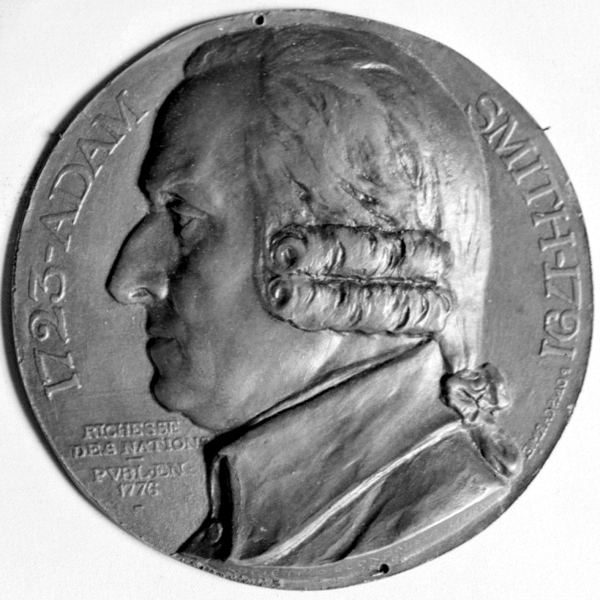
Adam Smith on a bronze medal by François-Joseph-Hubert Ponscarme, 1876 (Metropolitan Museum of Art, public domain). The only portrait made from life is a 1787 glass-paste medallion by James Tassie.
Smith said plainly that the books were parts of one plan. As a professor at Glasgow he taught a course in moral philosophy, and one of his students, John Millar, later described how it was organized. It had four parts:
| Part of the course | What Smith taught | What became of it |
|---|---|---|
| 1. Natural theology | The evidence for God and the parts of the human mind on which religion rests. | Lost. No notes survive. |
| 2. Ethics | How people come to judge right and wrong. | The Theory of Moral Sentiments (1759). |
| 3. Justice | How law and government grew from the earliest societies to modern ones. | Never finished. Two sets of student notes survive as the Lectures on Jurisprudence. |
| 4. “Expediency” | In Millar’s words, “those political regulations which are founded, not upon the principle of justice, but that of expediency,” meant to increase “the riches, the power, and the prosperity of a State.” | The Wealth of Nations (1776). |
In the last edition of The Theory of Moral Sentiments, Smith reminded readers that he had promised a third book on “the general principles of law and government.” In The Wealth of Nations, he wrote, “I have partly executed this promise.” The rest, “the theory of jurisprudence,” he had not been able to finish, and he admitted that at his “very advanced age” he had little hope of finishing it. He didn’t. Shortly before he died, he had his friends burn his unpublished papers, and the book on justice went with them.
This reading follows the method of the Minds Behind the Ideas series: the person, the idea, and the legacy. The Person sketches Smith’s life. The Idea explains The Theory of Moral Sentiments, gives a short version of The Wealth of Nations, and shows how the two fit together. The Legacy asks who claims Smith today and where he went wrong. Smith appears in more than a dozen other readings on this site, nearly always quoting The Wealth of Nations. This one spends most of its time on the book those readings leave out.
WATCH An Animal That Trades, Part 4: Sympathy (AdamSmithWorks, a project of Liberty Fund, a classical-liberal foundation, about 9 minutes. How Smith’s idea of sympathy connects to modern research on empathy)
The Person
1 A quiet life
Smith was born in Kirkcaldy, a small port across the water from Edinburgh. His exact birth date is unknown; he was baptized on June 5, 1723. His father, a customs official, had died a few months before he was born, and Smith stayed close to his mother all his life. He never married.
At 14 he went to the University of Glasgow, where he studied under the moral philosopher Francis Hutcheson. In 1740 he won a scholarship to Balliol College, Oxford, and stayed six years. He was not impressed. Years later he wrote in The Wealth of Nations that at Oxford “the greater part of the public professors have, for these many years, given up altogether even the pretence of teaching.” Back in Scotland, he gave a successful series of public lectures in Edinburgh starting in 1748. In those years he met David Hume, the philosopher and historian who became his closest friend.
In 1751 Glasgow made Smith professor of logic, and the next year professor of moral philosophy. The Theory of Moral Sentiments, published in 1759, made him famous. In 1764 he left the university to tutor the young Duke of Buccleuch on a tour of France and Switzerland. In Paris he met the French economists François Quesnay and Anne-Robert-Jacques Turgot, who were working on some of the same questions. The duke’s pension let Smith spend the next decade writing, mostly at home in Kirkcaldy. The Wealth of Nations appeared on March 9, 1776.
Two years later Smith became a Commissioner of Customs in Edinburgh. There is an irony here worth one sentence: the great critic of trade restrictions spent his last twelve years helping to enforce them. He died in Edinburgh on July 17, 1790.
Smith was private and careful. Hume was not. Hume was widely seen as an unbeliever, and when he died in 1776, Smith published a letter praising his friend’s calm and good humor at the end, calling him “as approaching as nearly to the idea of a perfectly wise and virtuous man, as perhaps the nature of human frailty will permit.” Four years later Smith wrote to Andreas Holt, a Danish official that “a very harmless Sheet of paper” about Hume’s death had “brought upon me ten times more abuse than the very violent attack I had made upon the whole commercial system of Great Britain.”
JUST FOR FUN Smith’s letter about the abuse he received (University of Glasgow Library, Special Collections. The original letter to Andreas Holt, in the library’s exhibit on Smith)
LISTEN Dennis Rasmussen on Hume and Smith and The Infidel and the Professor on EconTalk, November 6, 2017, with transcript. Political scientist Dennis Rasmussen tells host Russ Roberts the story of the friendship between the two men
The Idea
2 The Theory of Moral Sentiments: how we learn to judge
Smith’s first book asks a question that sounds simple: how do ordinary people come to know right from wrong? His answer doesn’t start with rules handed down from above. It starts with how people watch, imagine, and judge each other.
Sympathy. For Smith, sympathy doesn’t mean pity. It means fellow-feeling through imagination. We can’t feel what another person feels, but we can picture ourselves in their place and ask how we would feel. When our imagined feeling matches theirs, we approve of how they are acting. When it doesn’t, as when someone rages over a small slight, we disapprove. People also want the approval of others, so they learn to tone their feelings up or down to a level others can share.
The impartial spectator. Over time we learn to judge ourselves the same way, by imagining how a fair, well-informed observer would see our conduct. Smith called this observer the impartial spectator, or “the man within.” His most famous example is an earthquake that swallows up China. A decent man in Europe, Smith wrote, would express sorrow and then go back to his business. Yet “if he was to lose his little finger to-morrow, he would not sleep to-night; but, provided he never saw them, he will snore with the most profound security over the ruin of a hundred millions of his brethren.”
Here is Smith’s twist. Ask the same man whether he would sacrifice those hundred million lives to save his little finger, and he would be horrified. What stops him? Smith’s answer:
Justice and beneficence. Smith split the virtues into two kinds. Beneficence, or doing good for others, is admirable, but it can’t be forced. Justice, or not harming others, can and must be enforced. Beneficence, he wrote, “is the ornament which embellishes, not the foundation which supports the building.” Justice “is the main pillar that upholds the whole edifice.” A society can get by without much love, but not without justice: “Society may subsist among different men, as among different merchants, from a sense of its utility, without any mutual love or affection.”
Prudence. Smith counted looking after yourself as a virtue, not a vice. “The care of the health, of the fortune, of the rank and reputation of the individual,” he wrote, “is considered as the proper business of that virtue which is commonly called Prudence.” Prudence earns respect, though not the warm admiration we give to generosity. This matters for reading The Wealth of Nations: when Smith wrote about self-interest there, he meant something closer to prudence than to greed.
The worry. Smith didn’t think commercial society was all good for character. In the 1790 edition he added a new chapter on what he called “the great and most universal cause of the corruption of our moral sentiments”: the habit “to admire, and almost to worship, the rich and the powerful,” and to neglect the poor. People chase wealth because they think the rich are happy and admired, and they often confuse the admiration given to wealth with the respect owed to wisdom and virtue. The Moral Case for Markets links to an EconTalk conversation on this chapter.
TRY IT What Motivates Us? (AdamSmithWorks (Liberty Fund). A lesson built on the Ultimatum Game: one player offers to split a reward, the other can accept or turn it down, and if the offer is refused, neither gets anything. Try it with friends and see how often people turn down “unfair” offers that would still leave them better off)
READ THE ORIGINAL The Theory of Moral Sentiments, Part I (free at the Library of Economics and Liberty (Liberty Fund), sixth edition, 1790)
3 The Wealth of Nations: the short version
The Wealth of Nations is a long book, and other readings on this site cover much of it, from the pin factory to taxes. Its central argument fits in a few sentences. Once governments stop granting special favors and imposing special restrictions, Smith wrote, “the obvious and simple system of natural liberty establishes itself of its own accord. Every man, as long as he does not violate the laws of justice, is left perfectly free to pursue his own interest his own way.”
Notice the condition: “as long as he does not violate the laws of justice.” Smith also explained why governments should stop directing industry. No ruler could do it well, because it is a duty “for the proper performance of which no human wisdom or knowledge could ever be sufficient.” That leaves government with three duties, which Smith called “of great importance”:
The second duty is where the two books meet. The “laws of justice” that frame natural liberty are the same justice The Theory of Moral Sentiments called the main pillar of society.
The table shows where other readings on this site already cover Smith’s economics, so this one doesn’t repeat them.
| Smith’s idea | Where to read about it |
|---|---|
| The pin factory, the division of labor, and the extent of the market | Why Do We Trade?; What Makes Economies Grow? |
| The butcher, the brewer, and the baker; the invisible hand; “flourishing and happy” | The Moral Case for Markets |
| The diamond-water puzzle | Why Isn’t Good Good Enough? |
| Why dirty or dangerous jobs pay more | How Do People Respond to Prices? |
| “People of the same trade seldom meet together” | Why Do Profits and Losses Matter?; Who Really Runs the Economy? |
| Employers “combine” to hold down wages | Why Do Some Jobs Pay More Than Others?; Who Really Runs the Economy? |
| The “absurd” doctrine of the balance of trade | Is the Trade Deficit a Problem? |
| Defense and retaliation as exceptions to free trade | Who Pays for Tariffs? |
| The rules for a good tax | How Does the Government Tax, Spend, and Borrow? |
| The worker made “stupid and ignorant” by repetitive work, and the parish school | Will Technology Take Our Jobs?; Why Do We Trade? |
| The philosopher and the street porter | What Makes an Economy Just? |
| Smith’s limit on interest rates and Bentham’s reply | What Sets the Price of Borrowing? |
READ THE ORIGINAL The Wealth of Nations, Book IV, Chapter IX (free at the Library of Economics and Liberty; the system of natural liberty and the three duties appear near the end of the chapter)
4 How the two books fit
Five points show how the two books belong to one project.
- The course plan. Ethics came first in Smith’s course, then justice, then the policies that make a country rich. The books follow the same order.
- Smith’s own words. He called The Wealth of Nations a partial fulfillment of the promise he made at the end of The Theory of Moral Sentiments.
- Justice is the bridge. The “main pillar” of the first book is the “laws of justice” that set the limits of natural liberty in the second.
- Self-love is not selfishness. The butcher passage is about dealing with strangers, and the first book had already said that society can run among “different merchants” without love. It is also about persuasion: “We address ourselves, not to their humanity but to their self-love, and never talk to them of our own necessities but of their advantages.” In his Glasgow lectures, Smith said that “the offering of a shilling” is “in reality offering an argument to persuade one to do so and so as it is for his interest.” Trade, for Smith, is a form of talking people into things, not forcing them.
- The same humility. In The Theory of Moral Sentiments, Smith warned against “the man of system,” who “seems to imagine that he can arrange the different members of a great society with as much ease as the hand arranges the different pieces upon a chess-board.” He forgets that “in the great chess-board of human society, every single piece has a principle of motion of its own.” The Wealth of Nations makes the same point about economic planning: no human wisdom could ever be enough. Who Should Decide? and Markets, Planning, or Something in Between? take up the same idea through Friedrich Hayek.
Two invisible hands. Smith used the phrase “invisible hand” only three times: once in an early essay on the history of astronomy, once in each book. The Moral Case for Markets explains the use in The Wealth of Nations. The use in The Theory of Moral Sentiments is less familiar and a little darker. Smith describes “the poor man’s son, whom heaven in its anger has visited with ambition,” who wears himself out chasing wealth he imagines will make him happy. It won’t, Smith says. But “it is well that nature imposes upon us in this manner. It is this deception which rouses and keeps in continual motion the industry of mankind.” Rich landowners, wanting only luxuries, end up hiring and feeding so many people that they are “led by an invisible hand” to share the necessities of life almost as if the land had been divided equally. And in what truly makes for happiness, Smith adds, “the beggar, who suns himself by the side of the highway, possesses that security which kings are fighting for.”
“Das Adam Smith Problem.” In the 1800s, some German scholars argued that Smith had flipped from a theory of sympathy to a theory of selfishness, perhaps under French influence. The phrase they used, “Das Adam Smith Problem,” stuck. When the University of Glasgow published the standard modern edition of The Theory of Moral Sentiments in 1976, its editors, D. D. Raphael and A. L. Macfie, called it “a pseudo-problem based on ignorance and misunderstanding.” The 1790 revisions are hard to square with a flip. Still, some serious scholars see real tension. Samuel Fleischacker, in the Stanford Encyclopedia of Philosophy, writes that “it is unclear” how much The Wealth of Nations has to do with Smith’s philosophical concerns. The books fit together, but they don’t fit perfectly.
A modern heir. Vernon Smith (no relation), who shared the 2002 Nobel Prize in economics for laboratory experiments, has built on both books. In his Nobel lecture and later work he argues that people live in two kinds of order at once: a personal one of family and friends, run on sympathy and generosity, and an impersonal one of markets, run on justice, property, and promises kept. Trouble starts when we apply the rules of one to the other: when we run a family like a market, or try to run a whole economy as if it were a family.
The Legacy
5 Who claims Smith?
Almost everyone does. The political theorist Glory Liu, in Adam Smith’s America (2022), traces how Americans have remade Smith for their own purposes for 250 years.
- The founding era. The Wealth of Nations came out the same year as the Declaration of Independence. Americans of the founding generation read it, though they argued over what it meant for a new country.
- The 1800s. Smith became the patron of free trade. Others cited his concern for workers and his attacks on merchant privilege.
- The Chicago School. In the twentieth century, economists at the University of Chicago made Smith the great theorist of self-interest. George Stigler called The Wealth of Nations “a stupendous palace erected upon the granite of self-interest.”
- The moral philosopher returns. The Glasgow edition of Smith’s works, begun in 1976, put The Theory of Moral Sentiments back in view, and scholars began reading the two books together again.
Today Smith scholars sometimes sort into “left Smithians” and “right Smithians.” On the left, the historian Emma Rothschild and the economist Amartya Sen stress Smith’s concern for the poor and his distrust of merchants. Fleischacker points out that Smith described paying taxes as “a badge … of liberty.” On the right, Deirdre McCloskey and Vernon Smith stress his case for the dignity of ordinary commercial life and his distrust of rulers who think they know best. Both sides can quote him, because he wrote on both themes. Calling Smith left or right also imposes today’s labels on a man who died in 1790.
LISTEN Was Adam Smith Really a Right-Winger? on Freakonomics Radio, episode 526, December 14, 2022, with transcript. Host Stephen Dubner talks with Glory Liu, Dennis Rasmussen, Russ Roberts, Mariana Mazzucato, Eamonn Butler, and Craig Smith; the framing leans center-left
READ Was Adam Smith Really Like Freakonomics Suggests? (AdamSmithWorks (Liberty Fund), February 2, 2023. A reply arguing that the episode dwelt on left and right and on the differences between the two books instead of exploring how they connect)
6 What Smith got wrong, and what he saw early
A reading that only praised its subject would break this site’s own rules. Smith got several things wrong.
- Value. Smith treated labor as “the real measure” of value and explained prices mainly by costs of production. That left him unable to solve his own diamond-water puzzle. Economists solved it about a century later by looking at the value of one more unit, as Why Isn’t Good Good Enough? explains.
- “Unproductive” labor. Smith called the work of servants, and also of soldiers, lawyers, doctors, actors, and musicians, “unproductive,” because it left no lasting object behind to sell. Most of today’s economy is services, and economists no longer draw the line this way.
- A cap on interest rates. Smith supported a legal maximum on interest, set a little above the rate paid by the safest borrowers, so that money would not flow to “prodigals and projectors.” Jeremy Bentham answered him in Defence of Usury (1787): risky “projectors” are often the inventors who move an economy forward. What Sets the Price of Borrowing? tells that story.
- The shipping laws. Smith defended England’s Navigation Acts, which reserved trade for English ships, because “defence, however, is of much more importance than opulence.” Whether that was an error or wisdom is still argued; Who Pays for Tariffs? weighs it.
On slavery, Smith saw earlier and more clearly than many of his contemporaries. In The Theory of Moral Sentiments he wrote that Africans sold into slavery had a courage “which the soul of his sordid master is too often scarce capable of conceiving,” and called the slave traders “the refuse of the jails of Europe.” In The Wealth of Nations he argued that slave labor, “though it appears to cost only their maintenance, is in the end the dearest of any.” Then why did slavery last? Because “the pride of man makes him love to domineer.” His explanation for an evil that persists even though it doesn’t pay was moral, not economic.
Fair Challenges
Decide what you think of each challenge first, then open the response.
“Smith was a free-market absolutist.”
“Smith would support today’s welfare state.”
“His two books contradict each other.”
“The invisible hand means markets always produce good outcomes.”
“Commerce corrupts character.”
Reading Smith Today
Smith left questions that are still open:
READ Economics and the Ordinary Person: Re-reading Adam Smith (by Samuel Fleischacker, Library of Economics and Liberty, 2004. A Smith scholar who reads him as more egalitarian than the Chicago School did)
The Normative Question
Smith thought a good society needed both justice, which can be enforced, and virtues such as kindness and self-command, which can’t be. How much should we rely on markets and law to make a decent society, and how much on character, family, religion, and community? Evidence can show what markets and laws actually do. How much a society should ask of each is a question of values.
Key Terms in Plain Words
- Sympathy (Smith’s sense)
- Fellow-feeling: imagining yourself in another person’s place and sharing how they feel.
- Impartial spectator
- An imagined fair, well-informed observer we use to judge our own conduct; “the man within.”
- Prudence
- The virtue of taking sensible care of your own health, money, and reputation.
- Justice and beneficence
- Not harming others, which can be enforced, and doing good for them, which can’t.
- System of natural liberty
- Smith’s name for an economy where people may pursue their own interests as long as they obey the laws of justice.
- Man of system
- Smith’s term for a planner who thinks he can arrange society like pieces on a chessboard.
- Das Adam Smith Problem
- The claim that Smith’s two books contradict each other, now widely rejected.
- Invisible hand
- Smith’s phrase for good outcomes no one intended; see The Moral Case for Markets.
Sources
- Quotations, dates, and examples in this reading come from the sources below, current as of November 13, 2026.
- Smith’S Own Writings
- Adam Smith, The Theory of Moral Sentiments, 6th ed. (1790), Library of Economics and Liberty. Advertisement to the sixth edition econlib.org
- Smith, The Theory of Moral Sentiments, Part I (opening; sympathy; the corruption of moral sentiments) econlib.org
- Smith, The Theory of Moral Sentiments, Part II, Section II (justice and beneficence) econlib.org
- Smith, The Theory of Moral Sentiments, Part III (the earthquake in China; the man within) econlib.org
- Smith, The Theory of Moral Sentiments, Part IV (the poor man’s son; the invisible hand) econlib.org
- Smith, The Theory of Moral Sentiments, Part V (custom, fashion, and the slave trade) econlib.org
- Smith, The Theory of Moral Sentiments, Part VI (prudence; the man of system) econlib.org
- Adam Smith, An Inquiry into the Nature and Causes of the Wealth of Nations (1776), Cannan edition, Library of Economics and Liberty. Book I, Chapter II (the butcher, the brewer, and the baker) econlib.org
- Smith, The Wealth of Nations, Book I, Chapter VIII (“flourishing and happy”) econlib.org
- Smith, The Wealth of Nations, Book II, Chapter IV (the legal rate of interest) econlib.org
- Smith, The Wealth of Nations, Book III, Chapter II (slavery) econlib.org
- Smith, The Wealth of Nations, Book IV, Chapter II (the invisible hand; the Navigation Acts) econlib.org
- Smith, The Wealth of Nations, Book IV, Chapter IX (the system of natural liberty; the three duties) econlib.org
- Smith, The Wealth of Nations, Book V, Chapter I (Oxford professors; the effects of repetitive work; parish schools) econlib.org
- Adam Smith, Lectures on Jurisprudence (Glasgow Edition, 1978), report of 1762–63, vi.56 (“the offering of a shilling”), quoted in Jacob Sider Jost, “Bargaining with the Butcher, Baker, and Brewer: A New Look at Smith’s Most Famous Sentences,” EconLog, Library of Economics and Liberty, March 20, 2026 econlib.org
- Adam Smith, letter to William Strahan on the death of David Hume, November 9, 1776, published 1777, Library of Economics and Liberty econlib.org
- University of Glasgow Library, Special Collections, “Scottish Thought and Letters in the Eighteenth Century: Adam Smith” (Smith’s letter to Andreas Holt, October 1780) gla.ac.uk
- Life And The Course Plan
- University of Glasgow, “Biography of Adam Smith,” Adam Smith 300 gla.ac.uk
- James Otteson, “Brief Biography of Adam Smith,” AdamSmithWorks (Liberty Fund) adamsmithworks.org
- “Smith, Adam (1723–1790),” selected biographies, Carleton University (on Millar’s account, the 1778 customs appointment, and the burning of papers) carleton.ca
- John Millar’s account of Smith’s course, in Dugald Stewart, “Account of the Life and Writings of Adam Smith, LL.D.” (1793), reprinted in Smith, Essays on Philosophical Subjects (Glasgow Edition), quoted in the Glasgow Edition of the Lectures on Jurisprudence, Online Library of Liberty rosenfels.org
- National Galleries of Scotland, “The Life and Work of James Tassie” (video transcript; the Tassie medallion as the only portrait from life) nationalgalleries.org
- François-Joseph-Hubert Ponscarme, “Adam Smith, Political Economist,” medal, 1876, Metropolitan Museum of Art (public domain image) metmuseum.org
- Interpreting Smith
- Samuel Fleischacker, “Adam Smith’s Moral and Political Philosophy,” Stanford Encyclopedia of Philosophy plato.stanford.edu
- D. D. Raphael and A. L. Macfie, Introduction to Adam Smith, The Theory of Moral Sentiments (Glasgow Edition, Oxford University Press, 1976; Liberty Fund reprint) libertyfund.org
- Vernon L. Smith, “Constructivist and Ecological Rationality in Economics,” Nobel Prize lecture, December 8, 2002 nobelprize.org
- Glory M. Liu, Adam Smith’s America: How a Scottish Philosopher Became an Icon of American Capitalism (Princeton University Press, 2022) press.princeton.edu
- George J. Stigler, “Smith’s Travels on the Ship of State,” History of Political Economy 3, no. 2 (1971): 265–277 doi.org
- Jacob Viner, “Adam Smith and Laissez Faire,” Journal of Political Economy 35, no. 2 (1927): 198–232 doi.org
- Emma Rothschild, Economic Sentiments: Adam Smith, Condorcet, and the Enlightenment (Harvard University Press, 2001) hup.harvard.edu
- Gavin Kennedy, “Adam Smith and the Invisible Hand: From Metaphor to Myth,” Econ Journal Watch 6, no. 2 (2009): 239–263 econjwatch.org
- Daniel B. Klein and Brandon Lucas, “In a Word or Two, Placed in the Middle: The Invisible Hand in Smith’s Tomes,” Economic Affairs 31, no. 1 (2011) (working-paper version) competitionandappropriation.econ.ucla.edu
- James R. Otteson, “Economic Sentiments: Was Adam Smith a Liberal?” Carolina Journal (review of Rothschild; argument) carolinajournal.com
- Amartya Sen, “Adam Smith and the Contemporary World,” Erasmus Journal for Philosophy and Economics 3, no. 1 (2010): 50–67 doi.org
- Samuel Fleischacker, “Economics and the Ordinary Person: Re-reading Adam Smith,” Library of Economics and Liberty, 2004 econlib.org
- Videos, Podcasts, And Activities
- AdamSmithWorks (Liberty Fund), “An Animal That Trades, Part 4: Sympathy.” youtube.com
- AdamSmithWorks (Liberty Fund), “What Motivates Us?” (Ultimatum Game lesson) adamsmithworks.org
- EconTalk, “Dennis Rasmussen on Hume and Smith and The Infidel and the Professor,” hosted by Russ Roberts, November 6, 2017 (with transcript) econtalk.org
- Freakonomics Radio, “Was Adam Smith Really a Right-Winger?” episode 526, December 14, 2022 (with transcript) freakonomics.com
- Skwire, “Was Adam Smith Really Like Freakonomics Suggests?” AdamSmithWorks (Liberty Fund), February 2, 2023 (argument) adamsmithworks.org