When Does a Higher Price Pay Off?
Elasticity, pricing, and who really bears a tax
Start Here: Philadelphia’s Soda Tax
On January 1, 2017, Philadelphia began taxing sweetened drinks at 1.5 cents per ounce. That comes to about a dollar on a two-liter bottle. The law puts the tax on distributors, not on shoppers. But a team of marketing economists who tracked prices and sales in hundreds of stores found that stores passed almost all of it, 97 percent, on to customers. Prices of taxed drinks rose 34 percent, and sales of those drinks inside the city fell 46 percent.
That looks like a huge response. But many shoppers simply drove across the city line. Purchases at stores outside Philadelphia made up more than half of the lost sales in the city, so the total drop in taxed-drink purchases was only 22 percent.
The Foundations readings give us the starting point. Where Do Prices Come From? showed that a price is a signal: it tells buyers what they give up and tells sellers what to make. How Do People Respond to Prices? showed that people respond to prices, that responses grow with time, and that the person who sends a tax to the government is not always the person who bears it. This reading gives that responsiveness its name, elasticity, and puts it to work on two practical questions. When does raising a price bring in more money, and when does it bring in less? And when a tax raises a price, who really ends up paying? Why Do Profits and Losses Matter? comes next and shows what happens when sellers get these choices right or wrong.
What Elasticity Measures
Elasticity measures how much buyers or sellers change the amount they buy or sell when a price changes. Economists use percentages so they can compare very different goods: gallons of gas, concert tickets, and cigarettes. The Federal Reserve Bank of St. Louis puts the basic idea simply: if there are ten brands of lipstick and one brand raises its price, “it is easy to buy a different brand.” Demand for that one brand responds a lot. A flight to Australia has few substitutes, so demand for it responds less.
Three words cover most cases:
- Elastic: the quantity changes by a larger percentage than the price. Buyers respond a lot.
- Inelastic: the quantity changes by a smaller percentage than the price. Buyers respond a little.
- Unit elastic: the quantity changes by the same percentage as the price.
The idea is old. Alfred Marshall, the Cambridge economist who gave it its name in his Principles of Economics (1890), wrote that the elasticity of demand “is great or small according as the amount demanded increases much or little for a given fall in price, and diminishes much or little for a given rise in price.” Here is how much buyers respond in some real cases:
| Good | How buyers respond | What it shows |
|---|---|---|
| Cigarettes | A 10 percent price increase cuts adult smoking by about 3 to 5 percent at first, and by about 8 percent in the long run. Young people are up to three times as sensitive. | Inelastic, but less so over time and for young people. |
| Gasoline | A 10 percent price increase cuts gas use by about 0.6 percent within a few months, and by about 4 percent over 15 years or so. | Very inelastic at first. How Do People Respond to Prices? covers this case. |
| Bus fares | A typical estimate: each 1 percent fare increase cuts bus ridership by about 0.4 percent. | Inelastic. Many riders have few other ways to travel. |
| Driving into Manhattan | In the first year of the MTA’s congestion toll, which began January 5, 2025, vehicle entries into the toll zone fell by 27 million, or 11.7 percent. | Drivers responded, and the toll brought in more than $550 million in net revenue. |
| Soda in Philadelphia | Prices rose 34 percent. Sales in the city fell 46 percent, but total purchases fell only 22 percent. | Elastic at city stores, because the store across the line was a close substitute. |
What Makes Demand Respond More or Less
Why do smokers respond little to price, while Philadelphia soda buyers responded a lot? The answer is almost always about the choices buyers have. These are the main things that matter:
| What matters | Demand is more elastic when… | Example |
|---|---|---|
| Substitutes | Buyers can switch easily. | One lipstick brand versus a flight to Australia; city soda versus suburban soda. |
| How the good is defined | The category is narrow. | Demand for one brand of cola responds more than demand for drinks in general. |
| Share of the budget | The good takes a big share of income. | A rise in rent or car prices gets noticed. A rise in the price of salt barely does. |
| Time | Buyers have time to adjust. | Drivers barely change at first, then buy cars that use less gas. Smokers quit more over time. |
| Need and habit | Buyers can do without it. | Life-saving medicine versus a second streaming service. |
| Brand loyalty | Buyers don’t care much about the brand. | The St. Louis Fed notes that celebrity brands use loyal fans to make demand “more inelastic.” |
1 Sellers respond too
Supply has an elasticity as well. Sellers respond more when they can expand output easily and when they have time. A farmer can’t grow more wheat after the crop is in the ground, and a city can’t build more apartments in a month. That is why the supply of farm goods and housing is inelastic in the short run, a point Why Is Housing So Expensive? and Who Benefits from Farm Price Supports? build on. Over years, supply becomes more elastic as new builders, farms, and factories respond to the price.
2 Income and other prices
Buyers also respond to changes in their income and in the prices of other goods. Income elasticity measures how much the quantity demanded changes when income changes. For most goods, called normal goods, people buy more as their income rises. For some, called inferior goods, they buy less. OpenStax’s example is that as income rises, some people buy fewer hamburgers and more steak. Cross-price elasticity measures how demand for one good responds to the price of another. Substitutes, such as coffee and tea, move in opposite directions: a higher coffee price raises demand for tea. Complements, such as coffee and sugar, go together: a higher coffee price lowers demand for sugar too.
Setting the Price: Elasticity and Revenue
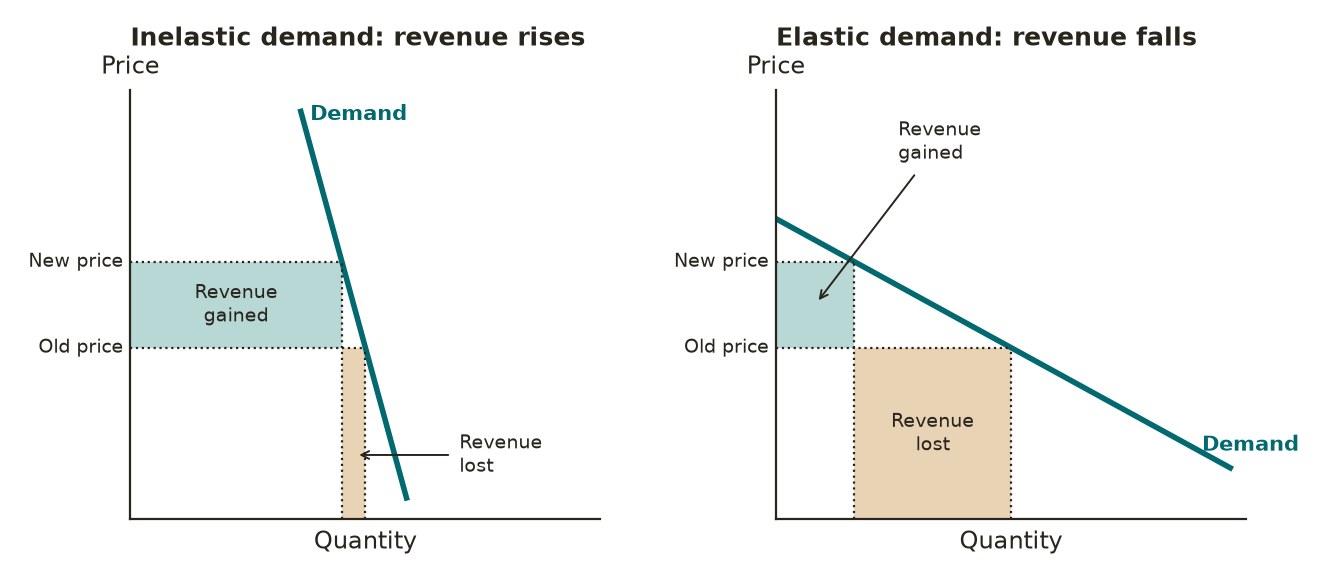
OpenStax’s Principles of Economics says that studying elasticity is useful for many reasons, “pricing being most important.” Its example is a band deciding what to charge for concert tickets. If demand is elastic, “the band should cut the price, because the percentage drop in price will result in an even larger percentage increase in the quantity sold—thus raising total revenue.” If demand is inelastic, “the band should raise the ticket price.” When demand is unit elastic, a small price change leaves revenue about the same, and that is where revenue is highest.
| If demand is… | A price increase… | A price cut… |
|---|---|---|
| Elastic | Lowers total revenue. Buyers leave faster than the price rises. | Raises total revenue. New buyers more than make up for the lower price. |
| Unit elastic | Leaves total revenue about the same. | Leaves total revenue about the same. |
| Inelastic | Raises total revenue. Most buyers stay. | Lowers total revenue. Few new buyers come. |
The graphs show why. Revenue is the price times the quantity sold, which is the area of a rectangle under the demand curve. A price increase adds a strip on top (revenue gained from buyers who stay) and removes a strip on the side (revenue lost from buyers who leave). Which strip is bigger depends on how steep the demand curve is.
3 Pricing decisions in the real world
- E-books. In a 2014 pricing dispute with a publisher, Amazon claimed that “if customers would buy 100,000 copies of a particular e-book at $14.99, then customers would buy 174,000 copies of that same eBook at $9.99,” so “at $9.99, the total pie is bigger.” That is Amazon’s claim, made in a fight over prices, not an independent study. But the logic is the elasticity rule: if cutting the price by a third raises sales by about three-quarters, demand is elastic and the lower price brings in more revenue. Because an extra copy of an e-book costs almost nothing to deliver, more revenue also means more profit.
- Fans who will pay almost anything. OpenStax notes that some popular bands face demand that is “inelastic right up to the point where the arena is full.” They could raise prices and still sell out. Some don’t, choosing a lower price “in the hope that fans will feel happier and spend more on recordings, T-shirts, and other paraphernalia.” A seller cares about more than one night’s ticket revenue.
- Bad harvests, steady checks. Demand for crops is inelastic, so a small crop can push prices up enough to offset the lost bushels. In the 2012 drought, the U.S. Department of Agriculture expected net farm income to be “fairly stable,” as in earlier drought years, with record farm receipts driven by “large price-led gains in corn and soybean receipts.” Farmers whose crops failed lost out. Farmers who still had a crop to sell gained.
- Surge pricing. Economists working with Uber used its surge prices, which rise when riders are many and drivers are few, to estimate how much riders respond to price at different points along the demand curve. The same rider responds differently at 2 a.m. in the rain than at noon on a sunny day, and a single fixed price can’t reflect that.
4 Different prices for different buyers
Some sellers charge different buyers different prices for the same good. Economists call this price discrimination. The word sounds bad, but the idea is simple. Movie theaters charge less for matinees and for seniors. Software firms give students discounts. Airlines charge business travelers, who must fly on a set day, more than vacationers, who can choose another day or not fly at all. In each case, the seller charges less to the buyers whose demand is more elastic and more to the buyers who will pay anyway.
It works only when the seller can tell buyers apart and stop low-price buyers from reselling to high-price buyers. Colleges are a large example. Financial aid means that students sitting in the same class often pay very different prices. Why Does College Cost So Much? looks at the gap between a college’s posted price and what students actually pay. Price discrimination can raise a seller’s profit and also let more people buy, because buyers who would never pay the full price get in at a lower one. Whether it is fair is a separate question, taken up in the Normative Question.
WATCH Introduction to Price Discrimination and The Social Welfare of Price Discrimination (Marginal Revolution University)
Who Really Pays a Tax?
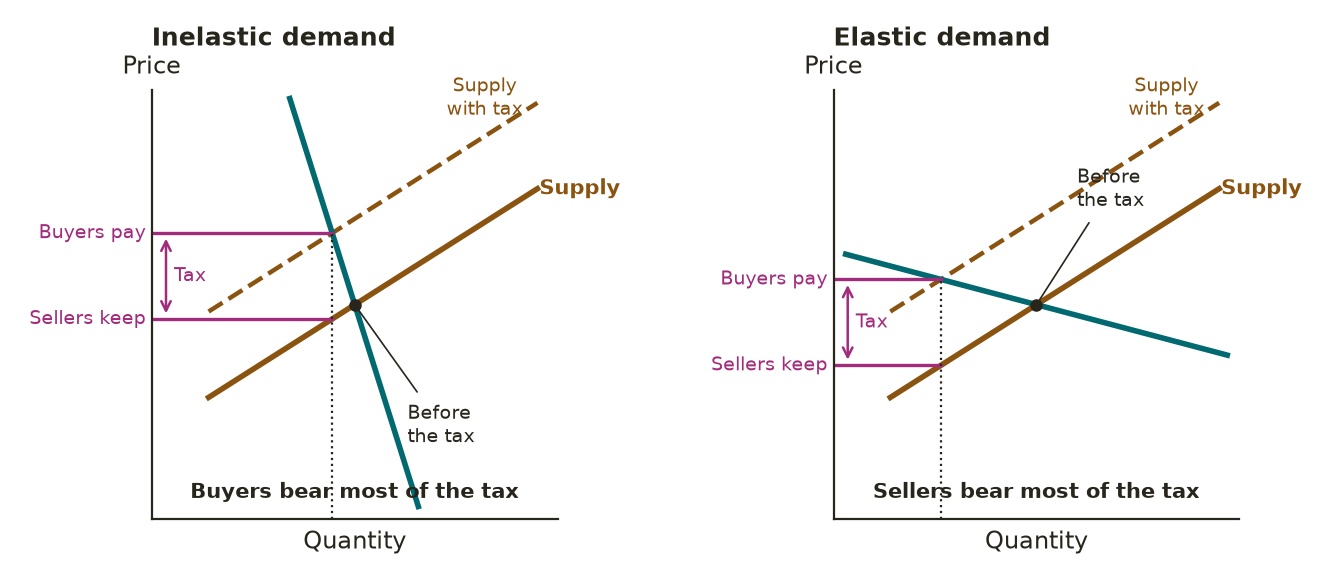
How Do People Respond to Prices? showed that the person who sends a tax to the government is not always the person who bears it. Elasticity tells us who does. In OpenStax’s words, “If demand is more inelastic than supply, consumers bear most of the tax burden, and if supply is more inelastic than demand, sellers bear most of the tax burden.” The side of the market that has fewer ways out pays more.
Five cases show the rule at work:
| Case | Who sends the tax | Who bears most of it | Why |
|---|---|---|---|
| Cigarettes | Sellers | Smokers | Demand is inelastic, especially for adults with a long habit. |
| Philadelphia soda | Distributors | City shoppers, except those who shopped outside the city | Prices rose by 97 percent of the tax. Shoppers who could leave the city avoided it. |
| Payroll taxes | Employers and workers, half each | Workers | The Congressional Budget Office counts the employer’s share as a cost to workers, because “employers appear to pass on their share of payroll taxes to employees by paying lower wages than they otherwise would.” |
| Tariffs | Importers | Mostly U.S. buyers in recent studies | Who Pays for Tariffs? covers this case. |
| 1990 luxury tax | Sellers of yachts, aircraft, furs, and jewelry | Many of the businesses and workers who built and sold them | Wealthy buyers could wait or buy something else. Builders had fewer options. |
5 The 1990 luxury tax
In 1990 Congress passed a 10 percent tax on the part of the price above $30,000 for cars, $100,000 for boats, $250,000 for aircraft, and $10,000 for furs and jewelry. It took effect on January 1, 1991. The idea was to tax people who could afford to pay. But buyers of yachts and furs had choices, including the choice to wait. According to the Internal Revenue Service, four of the five taxes were repealed effective January 1, 1993, “in part due to the damage done to the businesses providing these goods as wealthy individuals simply delayed their purchases.” The boat tax brought in about $34 million over its life. The car tax stayed and was phased out by 2002.
The same rule runs through the Policy Trade-offs readings. Does Rent Control Make Housing Affordable? shows landlords adjusting over years by selling or converting buildings. Does the Minimum Wage Help Low-Wage Workers? shows the costs of a wage floor landing on hours, newcomers, customers, and owners. In each case, the side that can adjust least ends up bearing more.
The Seen and the Unseen
A price change has effects we see right away and effects that are easy to miss. The seen effect is the price on the receipt. The unseen effects are the choices people make because of it.
| Case | The seen | The unseen |
|---|---|---|
| Soda tax | A higher price on the shelf in the city. | Sales moving to suburban stores, out of reach of the tax. |
| Luxury tax | A tax on the rich, paid at the time of sale. | Boats never ordered, and lost work for the people who would have built them. |
| Payroll tax | The employer’s share on the pay stub. | Lower wages than workers would otherwise earn. |
| Congestion toll | A new charge to drive into Manhattan. | Trips shifted to transit, to other times, or not taken at all. |
Marshall saw that the unseen effects often take time to appear. “Time is required,” he wrote, “to enable a rise in the price of a commodity to exert its full influence on consumption.” People need time to learn about substitutes, and producers need time to make them. When wood and charcoal grew expensive in England, he noted, people switched to coal only slowly, and fireplaces “were but slowly adapted to its use.” That is why a tax or toll that seems to change little in its first year may change much more later, and why forecasts based only on the first response can be wrong.
READ THE ORIGINAL Principles of Economics, Book III, Chapter IV, “The Elasticity of Wants” (by Alfred Marshall, 8th edition (1920), free at the Library of Economics and Liberty)
Using Elasticity in Policy: Two Debates
Elasticity is a tool, not a side in a debate. People who disagree about policy use the same tool and reach different conclusions because they weigh the results differently.
6 Should taxes fall on what people can’t give up?
The case for. In 1927 the mathematician Frank Ramsey showed that if a government must raise a set amount of money, it disturbs people’s choices least by setting taxes so that they cut the amount bought of each good by about the same share. That means higher tax rates on goods with inelastic demand, because people keep buying them. Public health advocates add that cigarette taxes both raise money and cut smoking, especially among young people, who respond up to three times as much as adults.
The case against. Goods with inelastic demand are often necessities or habits, so critics argue that a tax on them falls hardest on the people least able to change, and takes a larger share of income from poorer households. A tax that looks dependable in its first year may also bring in less over time, as buyers find substitutes. Philadelphia’s city line showed how fast that can happen.
7 Should prices rise when demand is high?
The case for. Prices that rise when many people want something bring out more supply and send the good to the people who value it most. Economists studying Uber estimated that in 2015 its riders received about $1.60 in value for every dollar they spent, about $6.8 billion across the United States. Surge pricing was part of how the service matched riders and drivers.
The case against. Raising prices when people need something most can feel like taking advantage of them. Many states limit it. South Carolina makes it unlawful, after the governor declares a state of emergency, to sell food, water, gas, lumber, lodging, and other goods at an “unconscionable price,” one that grossly exceeds the average price of the 30 days before. Supporters say such laws protect people in a crisis. Critics say they discourage sellers from bringing in supplies when they are needed most.
Fair Challenges
- “Businesses just pass every tax on to customers.” Sometimes they pass on almost all of it, as with Philadelphia’s soda tax, but that depends on elasticity, not on what the law says. When buyers have good substitutes, sellers absorb more. Payroll taxes are largely passed to workers instead. Where a tax lands is a question the evidence can answer. Who ought to bear it is a question of values.
- “Companies can charge whatever they want.” They can post any price, but buyers decide how much to buy. A seller facing elastic demand loses revenue when it raises prices, which is why Amazon wanted lower e-book prices. Sellers with few competitors have more room, a point a later reading on competition policy takes up. How much pricing power is too much is partly a question of values.
- “Cutting a price always means less money.” Only when demand is inelastic. When demand is elastic, a lower price brings in enough new buyers to raise revenue. This is a question of evidence about each market.
- “Tax yachts and furs. The rich will pay it.” The 1990 luxury tax suggests otherwise. Wealthy buyers put off purchases, and much of the cost fell on the businesses and workers who built and sold the goods. Four of its five parts were repealed within two years. Whether the rich should pay more is a question of values. Which tax actually makes them pay is a question of evidence.
- “Cigarette taxes are a dependable way to raise money and cut smoking.” Both can be true at once, because adult demand is inelastic, so revenue holds up while smoking falls somewhat, especially among the young. But the burden falls mostly on smokers who keep smoking, and critics argue that it takes a larger share of income from poorer smokers. How to weigh better health against that burden is a question of values.
- “Charging different people different prices is unfair.” It can let more people buy, as with student discounts and financial aid, and it can also take more from buyers who have no other choice. Who gains and who pays more is a question of evidence about each case. Whether it is fair is a question of values.
Notice what evidence can settle and what it can’t. How much buyers and sellers respond, and therefore who bears a tax and whether a price change raises revenue, are empirical questions, and careful studies answer many of them well. Whether the burden lands on the right people, and whether a price is fair, are questions of values.
What Economics Adds
Elasticity turns a general truth, that people respond to prices, into something we can measure and use. It explains why a seller sometimes earns more by charging less, why a drought need not ruin farm income, and why a tax aimed at one group can land on another. It does not say which prices are fair or which taxes are wise. It tells us who will actually bear the cost, so the choice can be made with open eyes.
READ The Price Elasticity of Demand and Celebrity Brands (Open Vault, Federal Reserve Bank of St. Louis, June 2024)
READ Elasticity and Pricing (OpenStax, Principles of Economics 3e, Section 5.3, free online)
LISTEN Richard McKenzie on Prices on EconTalk, June 23, 2008, with transcript. Economist Richard McKenzie explains why movie popcorn costs so much, why stores hold sales after Christmas, and how sellers charge different buyers different prices.
The Normative Question
Economics can show how much buyers respond to a price, why sellers charge different prices at different times and to different people, and who gains and who pays more as a result. It can’t decide whether those prices are fair. Is it fair for sellers to charge more when buyers need something most, as with surge pricing or prices after a storm? Is it fair to charge different buyers different prices, as with student discounts, airline fares, and college financial aid? Your answer depends on how you weigh getting goods to people who need them against protecting people when they have few choices, and on whether you trust prices or rules to do that job better.
Key Terms in Plain Words
- Price elasticity of demand
- How much the quantity buyers want changes when the price changes, in percentage terms.
- Price elasticity of supply
- How much the quantity sellers offer changes when the price changes.
- Elastic
- Quantity changes by a larger percentage than price.
- Inelastic
- Quantity changes by a smaller percentage than price.
- Unit elastic
- Quantity changes by the same percentage as price.
- Total revenue
- The price times the quantity sold; the money coming in.
- Income elasticity
- How much demand changes when buyers’ income changes.
- Cross-price elasticity
- How much demand for one good changes when the price of another changes.
- Substitutes
- Goods that can replace each other, such as coffee and tea.
- Complements
- Goods used together, such as coffee and sugar.
- Tax incidence
- Who actually bears the cost of a tax, whoever sends it to the government.
- Price discrimination
- Charging different buyers different prices for the same good.
Sources
- Quotations, figures, examples, videos, and the podcast in this sheet come from the sources below, current as of November 8, 2026.
- Philadelphia’S Soda Tax
- City of Philadelphia, Department of Revenue, “The Philly Beverage Tax starts January 1, 2017!” phila.gov
- City of Philadelphia, “Philadelphia Beverage Tax.” phila.gov
- Stephan Seiler, Anna Tuchman, and Song Yao, “The Impact of Soda Taxes: Pass-Through, Tax Avoidance, and Nutritional Effects,” Journal of Marketing Research 58, no. 1 (2021): 22–49 journals.sagepub.com
- What Elasticity Measures
- Samuel Jordan-Wood, “The Price Elasticity of Demand and Celebrity Brands,” Open Vault, Federal Reserve Bank of St. Louis, June 26, 2024 stlouisfed.org
- Alfred Marshall, Principles of Economics, 8th ed. (1920), Book III, Chapter IV, “The Elasticity of Wants,” Library of Economics and Liberty econlib.org
- National Cancer Institute, Tobacco Control Monograph 14, Changing Adolescent Smoking Prevalence, Chapter 12, pp. 193–194 (cigarette price elasticity) cancercontrol.cancer.gov
- Congressional Budget Office, Effects of Gasoline Prices on Driving Behavior and Vehicle Markets, January 2008 cbo.gov
- Transit Cooperative Research Program, TCRP Web Document 12, Transit Fare Elasticities (Transportation Research Board), March 2000 onlinepubs.trb.org
- MTA Bridges and Tunnels, Central Business District Tolling Program, Key Performance Metrics, January 26, 2026 mta.info
- MTA, “MTA Receives American Public Transportation Association’s 2025 Innovation Award” (program start date) mta.info
- What Makes Demand Respond More Or Less
- OpenStax, Principles of Economics 3e, Section 5.4, “Elasticity in Areas Other Than Price.” openstax.org
- Setting The Price
- OpenStax, Principles of Economics 3e, Section 5.3, “Elasticity and Pricing.” openstax.org
- OpenStax, Principles of Economics 3e, Section 9.2, “How a Profit-Maximizing Monopoly Chooses Output and Price” (revenue and profit) openstax.org
- Publishing Perspectives, “Amazon Explains Why It Thinks $9.99 Is the Right Price for Ebooks,” July 31, 2014 (Amazon’s claim) publishingperspectives.com
- U.S. Department of Agriculture, Economic Research Service, Charts of Note, 2012 drought and farm income ers.usda.gov
- Peter Cohen, Robert Hahn, Jonathan Hall, Steven Levitt, and Robert Metcalfe, “Using Big Data to Estimate Consumer Surplus: The Case of Uber,” NBER Working Paper 22627, September 2016 nber.org
- Who Really Pays A Tax?
- Congressional Budget Office, The Distribution of Household Income in 2021, 2024 (payroll tax incidence) cbo.gov
- Internal Revenue Service, Statistics of Income, “Federal Excise Taxes” (1990 luxury tax and repeal) irs.gov
- Using Elasticity In Policy
- Frank P. Ramsey, “A Contribution to the Theory of Taxation,” Economic Journal 37, no. 145 (1927): 47–61 doi.org
- South Carolina Code of Laws, Title 39, Chapter 5, Section 39-5-145 (price gouging during an emergency) scstatehouse.gov
- Videos (YouTube)
- Marginal Revolution University, “Introduction to Price Discrimination.” youtube.com
- Marginal Revolution University, “The Social Welfare of Price Discrimination.” youtube.com
- Podcast
- EconTalk, “Richard McKenzie on Prices,” June 23, 2008 econtalk.org